
British Vintage Stereoscopy — Viewer
True-View
A catalogue entry from the collection
| Name | True-View |
| Manufacturer | Signalling Equipment Ltd (owned by J & L Randall Ltd) |
| Date Period | Early 1950s |
| Materials | Plastic, glass, metal |
| Format | 35mm B/W roll film |
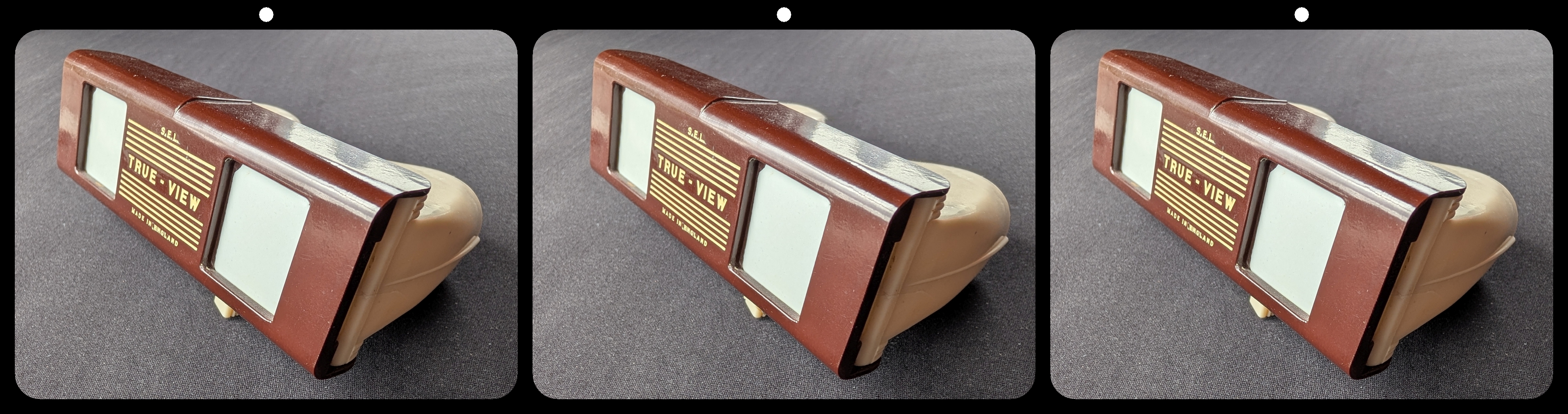
Caption describing the photograph of the viewer.
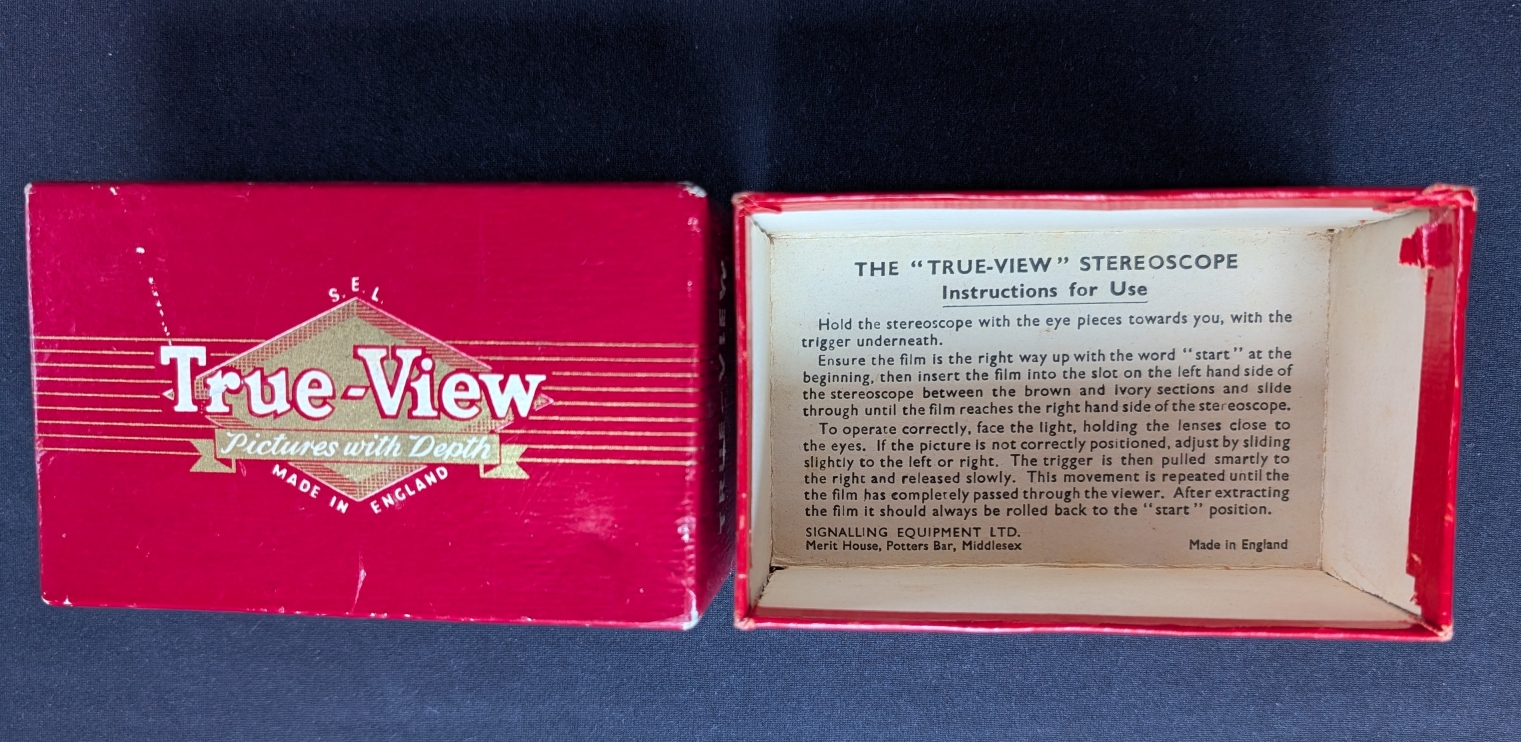
True-View box (with instructions).
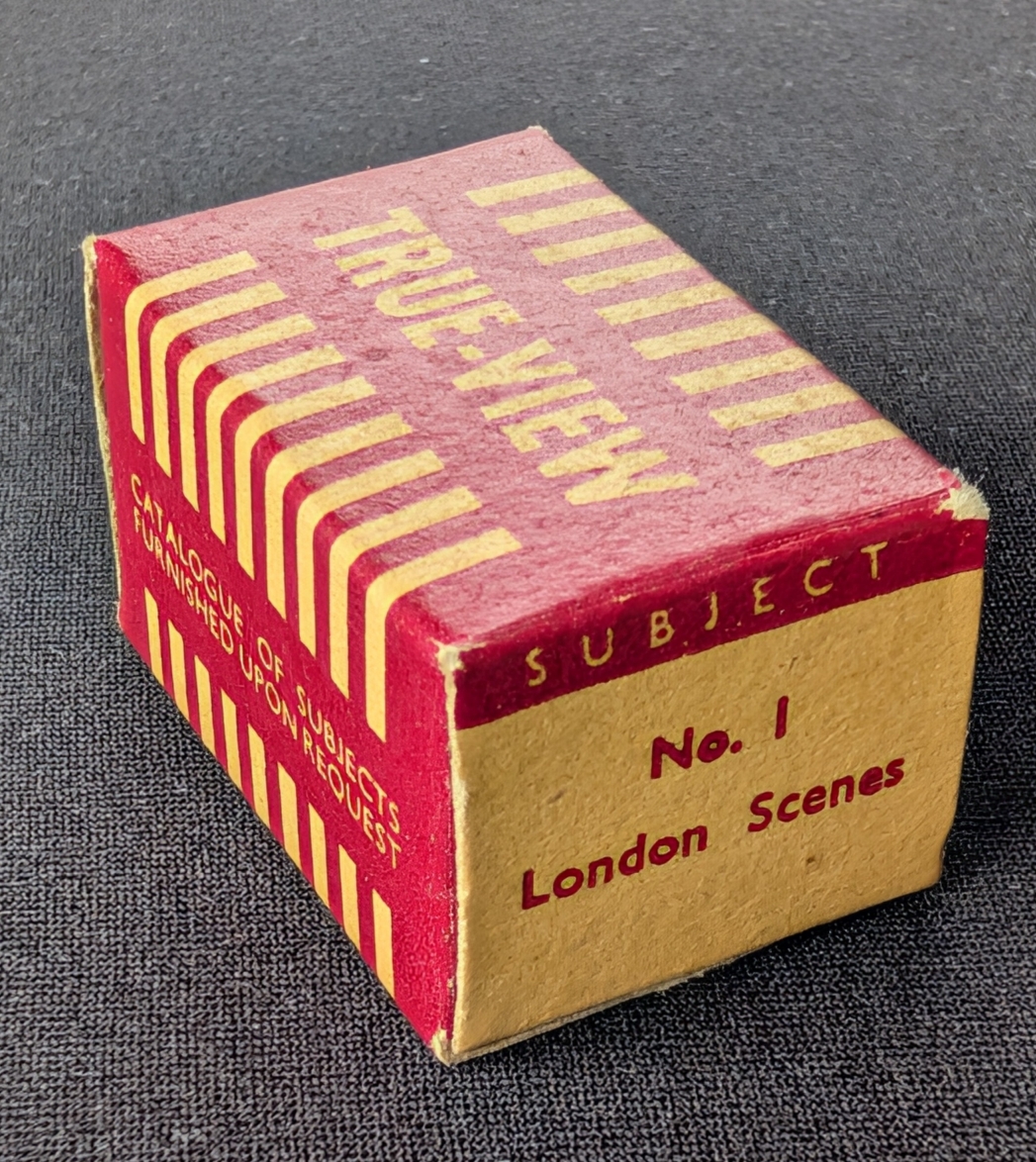
True-View Film Roll.
True-View is an interesting one. It was made by Signalling Equipment Ltd. (or S.E.L.), a subsidiary of J & L Randall Ltd., a well-known British toy and game manufacturer that also sold products under the more well known "Merit" brand name. S.E.L. was headquartered at Merit House in Potters Bar, Middlesex, England.
S.E.L. are thought to have come into existence during World War 2 when they made morse keys and such like (ie signalling equipment!) and after the war, they were mainly known for science based items - student microscopes, electric motors, compasses, model steam engines etc, while the Randalls's Merit brand were rooted more in traditional toys and board games.
True-View would therefore appear to be a bit of a departure for them but perhaps an attempt at getting into the “3D viewer” market which was growing again, aided by the rise in popularity of View-Master after the war. The viewer cost 18 shillings and 6 pence (18/6) according to a period advert I found - 92.5p in modern decimalized currency, and the same price as the Sightseer viewer from around the same time. For that price you got the viewer itself and not 1 but 2 film rolls. The viewer was constructed from two-part moulded plastic - a cream-coloured body with a dark brown faceplate. While a similar size and shape, it feels lighter and less solid than the Sightseer viewer.
For many enthusiasts, there’s a big “elephant in the room” when True-View is mentioned, so let’s address that next!
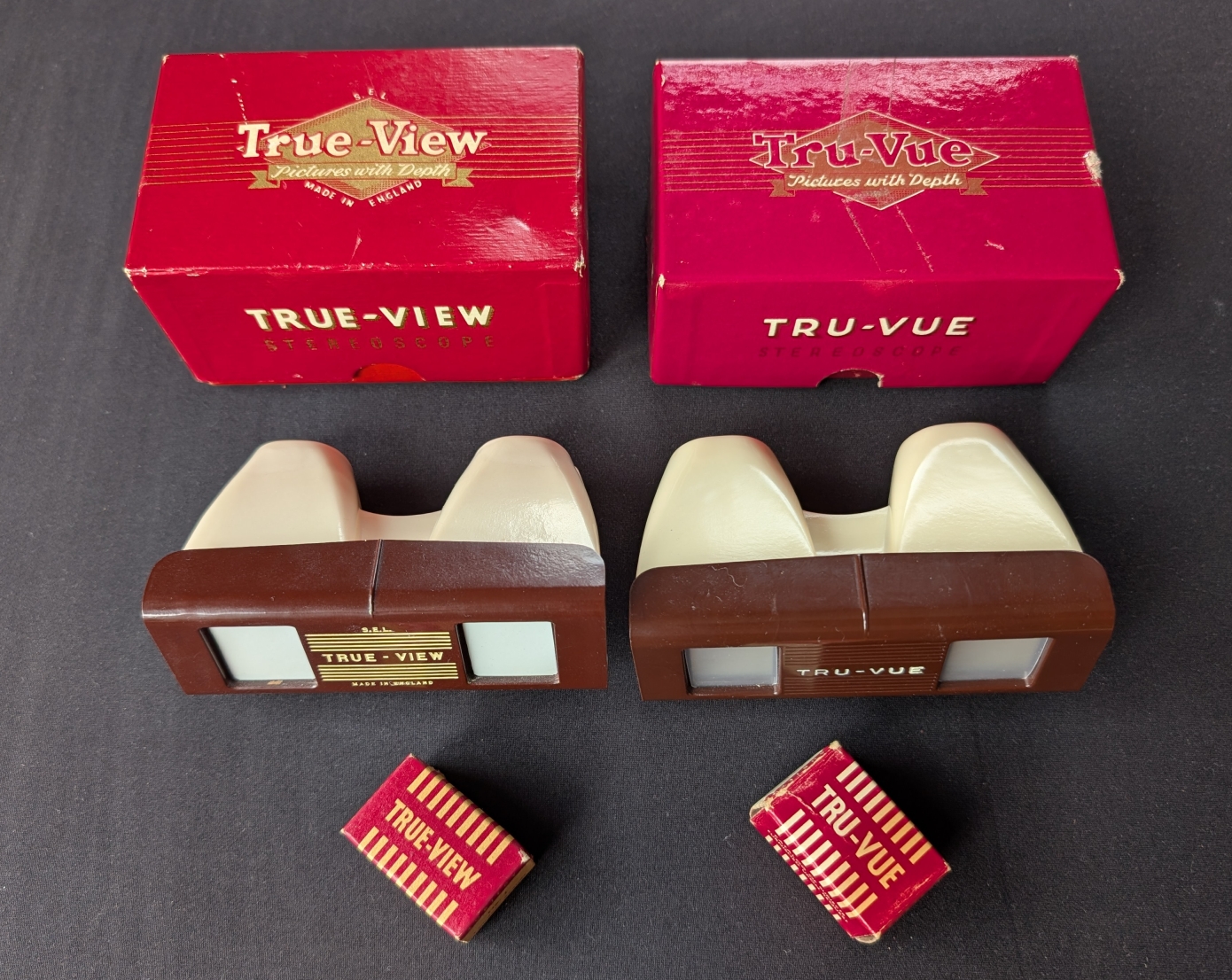
True-View alongside Tru-Vue
As you can see True-View looks somewhat “similar” (cough cough) to the American Tru-Vue format, which had been around since the 1930s. Was this legal, you might wonder? Well…probably, actually. As with so much from that period, definitive facts are hard to come by but there are 3 possibilities:
- 1
- The English company ripped off Tru-Vue completely and True-View was therefore an illegal copy.
- 2
- In 1951, Tru-Vue was bought out by Sawyer’s (the parent company of View-Master) and moved away from the old filmstrip style and redesigned the Tru-Vue brand to focus on a new stereo card format. Sawyer's possibly sold everything relating to the American filmstrips, viewers and package design directly to S.E.L. in England.
- 3
- Tru-Vue may have entered into a legitimate agreement with S.E.L. prior to the 1951 buyout to reproduce the design legally across the Atlantic, including the rights.
We do know that in 1949, the American company’s senior sales guy stated that England, having been one of their big foreign markets, was now unavailable to them due to the devaluation of the pound. That suggests to me that #3 is most likely - the American company couldn’t export to the UK and came to an agreement with J & L Randall whereby the English company bought the rights to make the viewers, create their own stereo film rolls and copy the packaging (suitably tweaked for the name change). New money made from an old format, for a company on the decline. It makes no sense at all that a legitimate British company would make an illegal copy of an American product - I’m not aware of that ever happening here and there's no evidence I found to back that up.
Like the American format, the British True-View films contained 14 stereo pairs, title and end frames and had 5 perforations per image. That’s where the similarities end, however. For 1 thing, while there were several hundred American Tru-Vue rolls, S.E.L. only produced and sold 30 stereo film rolls in total; all are a mix of scenic, cultural, and contemporary transport British subjects and all are different to Tru-Vue ones. They were also in true black and white; the American ones were more commonly sepia toned black and white (and - by the late 1940s - in colour). I have created a full list of the 30 Tru-View titles which can be found HERE.
It seems that with the similarity in many subjects (including the 1951 Festival of Britain), that True-View was on the market at around the same time as the slightly more expensive Sightseer. There are no clues left by history to tell us which was the more popular. One would think with over twice as many film rolls issued, Sightseer would have been the more successful and longer lasting - but they are actually harder to find than True-View. In any case, the film roll format was considerably more fiddly and archaic in design than other stereo formats like View-Master or the Coronet/Conway Pictures black and white print offerings from around the same time, so the shelf life of True-View was probably quite short.
I started by saying this viewer was sold by Signalling Equipment Ltd, and that’s true - but at some point they were also marketed under J & L Randall’s other brand, Merit, as you can see from the photo below. Perhaps this happened towards the end of its life as the parent company redefined the products associated with the 2 brands.
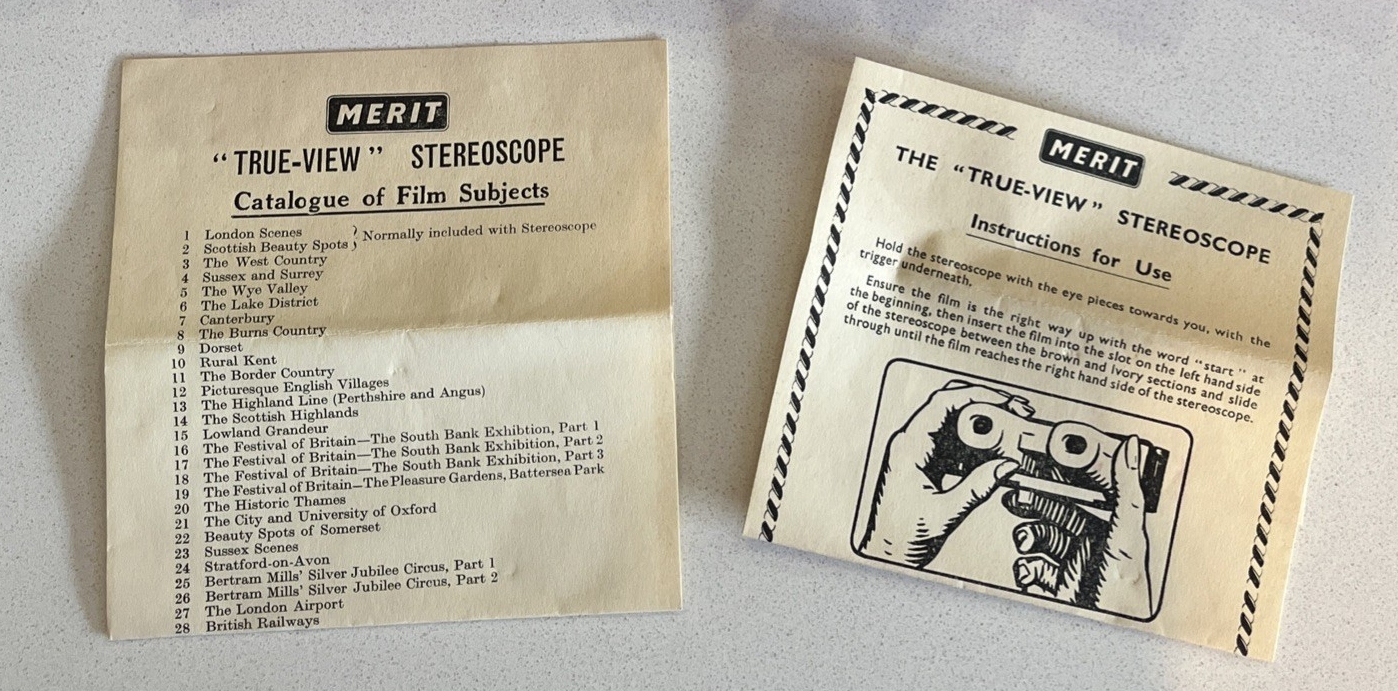
Merit branding.
Either way, while not as common as Vistascreen or View-Master, True-View shouldn’t be expensive to acquire; at the time of writing (Summer 2026) there are several sets of "viewer plus some rolls" on eBay UK and ideally should be had for around £40 or less. Those asking more really need to have them in pristine working condition, with box etc. It might take you far longer to find all the stereo film rolls though; I don’t yet have them all myself but will be reproducing the ones I do have on this site in the future.
Further Reading & Web Links
Image Sets To View (More to be added over time)
- Series 01 - London Scenes
- Series 28 - British Railways
- Many more coming soon
If you enjoyed this article - why not subscribe to the accompanying SUBSTACK NEWSLETTER? This will summarise all new additions to this site in an occasional email - with a link to the full articles here, as well as include anything else stereo related that doesn't quite fit on the site. Alternatively, just bookmark or add this site to your favourites and remember to stop by regularly and see what's new!
No comments:
Post a Comment